Spoiled for Good: The Real Reason Great Pizza Breaks Your Brain
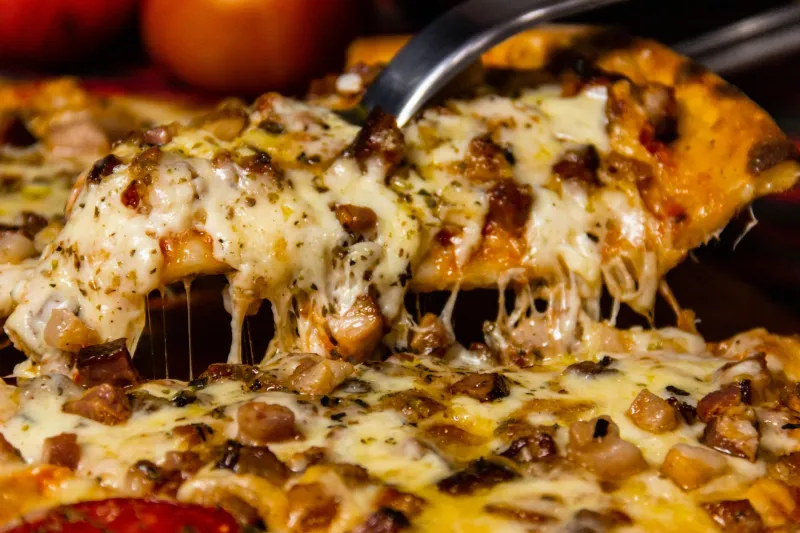
Somewhere between your first bite of a properly fermented crust and the moment the cheese pulls away in one clean, molten stretch, something shifts. It's subtle. You might not notice it happening. But a few weeks later, when you're standing in line at some forgettable pizza counter — the kind with a sneeze guard and a heat lamp — you'll feel it. That low-grade disappointment settling in before you've even taken a bite. That quiet, nagging sense that something is missing.
This isn't pickiness. It's not food snobbery. It's neuroscience, and it has a name.
Your Brain on a Really Good Pizza
When you eat something genuinely exceptional — and we mean genuinely, not just "pretty good for a Tuesday" exceptional — your brain releases a cascade of dopamine that's different in character from the everyday reward response. Neuroscientists who study food pleasure describe this as a peak hedonic experience, and the interesting thing about peaks is that they establish new baselines.
In simpler terms: your brain files away the best version of something it has ever encountered and uses that memory as the new reference point for all future comparisons. It's the same mechanism that makes your childhood home feel smaller when you visit as an adult, or makes a decent cup of coffee taste flat after a week in a city with a serious coffee culture.
Apply that to pizza and you start to understand why Piezano's customers describe other pizzerias the way they do — not with hostility, but with a kind of resigned sadness. "It's fine," they say. "It's just not the same."
It literally isn't the same. And their brains know it.
The Baseline Problem
Researchers who study sensory memory have documented what's sometimes called the contrast effect in food perception. When your palate has experienced a high reference point — a crust with real structural integrity, a sauce built from tomatoes that were actually allowed to ripen, cheese that melts instead of congealing — it unconsciously scores every subsequent experience against that benchmark.
Mediocre pizza doesn't just taste neutral after that. It can actually taste worse than it did before you had the great version. Your brain isn't being dramatic. It's doing exactly what it's supposed to do: using past experience to evaluate present reality.
This is why the Piezano's effect isn't a marketing talking point. It's a documented quirk of human perception. And it explains something we hear from customers all the time — that after their first order, they stopped bothering to try other places during the week. Not because they're loyal in some abstract sense, but because the cognitive dissonance of eating inferior pizza after experiencing the real thing just isn't worth the trouble.
What Makes the Experience Stick
Not every good meal creates this kind of neural imprint. For the effect to take hold, a few things have to happen simultaneously.
First, multiple sensory channels have to be satisfied at once. Smell, texture, taste, and even the visual presentation of the pizza all need to align. A pizza that smells incredible but arrives looking sad doesn't complete the circuit. Neither does a beautiful pizza that delivers flat flavor. When everything works together — the char on the crust, the aroma of fresh basil hitting hot cheese, the weight of the slice in your hand — the brain encodes the experience more deeply.
Second, there has to be an element of surprise or exceeded expectation. Neuroscientists call this prediction error, and it's one of the most powerful drivers of memory formation. When something is better than you expected, the dopamine response is amplified. First-time Piezano's customers who were expecting "pretty good delivery pizza" and got something that stopped them mid-sentence — that's prediction error doing its work.
Third, the experience has to feel repeatable. This is subtle but important. A once-in-a-lifetime meal at a special-occasion restaurant creates a powerful memory, but it also gets filed under "exceptional circumstances." When exceptional quality shows up on a regular Tuesday night, delivered to your door, your brain doesn't quarantine it as a rare event. It reclassifies it as what pizza should always be.
The Disappointment Is the Proof
Here's the counterintuitive part: the fact that other pizza starts to taste worse is actually evidence that your palate is working correctly. You haven't become impossible to please. You've become accurately calibrated.
Think about it this way. Before you had a reference point for what properly developed dough tastes like, you couldn't miss it. You didn't know what you were missing. But once that knowledge exists — once your taste memory holds a real example — the absence of it becomes perceptible in a way it simply wasn't before.
This is why people who grew up eating great regional pizza — a New Yorker who moved to the Midwest, a Chicago native living on the West Coast — describe the local pizza with such specific frustration. They're not being difficult. They have an internal reference that makes the gap visible.
Piezano's customers develop that same kind of reference. And once you have it, you can't unknow it.
Living With the Condition
If you've reached this point and recognized yourself in it — if you've felt that particular pizza disappointment and wondered why it hits harder than it used to — welcome to the club. It's a large one, and its members are spread across every zip code we deliver to.
The good news is that the cure is also the cause. The easiest way to fix a mediocre pizza experience is to immediately follow it with a good one. Your brain is remarkably good at restoring its own equilibrium when given the right inputs.
The better news is that you don't have to leave the house for it.
There's something almost poetic about the whole thing. A single great pizza experience sets a standard so high that everything else feels like a step down — and the only logical response is to stop settling. To just order the pizza that set the standard in the first place and skip the part where you try to convince yourself that something lesser will do.
Your brain already knows it won't. Might as well listen to it.