Born in America: The Unlikely Origin Story of Pepperoni and How It Conquered Every Pizza Box in the Country
Ask someone to name their favorite pizza topping and there's a solid chance they don't even hesitate. Pepperoni. It's the answer that comes out almost automatically, the one that shows up on more American pizzas than any other ingredient by a wide margin. But here's the thing almost nobody stops to think about: pepperoni, as we know it, is not Italian. Not even a little bit.
If you walked into a salumeria in Naples or Rome and asked for pepperoni, you'd probably get pointed toward a pile of bell peppers — because peperoni in Italian just means peppers. The cured, spiced, slightly greasy sausage that Americans pile onto pizza by the handful? That's a product of the United States, born out of the immigrant experience and shaped by the specific conditions of the American food industry in the early 20th century.
The story of how it got there is genuinely fascinating.
What Italian Immigrants Actually Brought With Them
When waves of Southern Italian immigrants arrived in the United States between the 1880s and 1920s, they brought their food traditions with them — and those traditions were rich. Salami, soppressata, capicola, various styles of dried and cured sausage. These were products of specific regions, made with specific techniques, and deeply tied to local ingredients and climates.
The problem was that America wasn't Southern Italy. The ingredients were different. The climate was different. The available cuts of meat, the spice sources, the casings — all of it required improvisation. Italian-American butchers and deli owners began adapting their old-country techniques to new-world conditions, blending together influences from multiple Italian regional traditions and adjusting recipes to work with what was actually available.
Pepperoni emerged from this process sometime in the early 1900s — a hybrid product, softer than traditional Italian salami, more heavily spiced with paprika and chili, and made to appeal to a broader American palate. The first documented appearances of the word "pepperoni" in American contexts date to around 1919, and it spread quickly through Italian-American delis and pizzerias in cities like New York, Chicago, and Philadelphia.
Pizza and Pepperoni Find Each Other
Here's where timing matters. Pizza itself was still a relatively niche food in the United States through the 1930s and into the 1940s — known primarily in Italian-American neighborhoods and not yet the mainstream staple it would become. When soldiers returned from World War II having eaten pizza across Italy, demand exploded. Pizzerias began multiplying across the country, and they needed toppings.
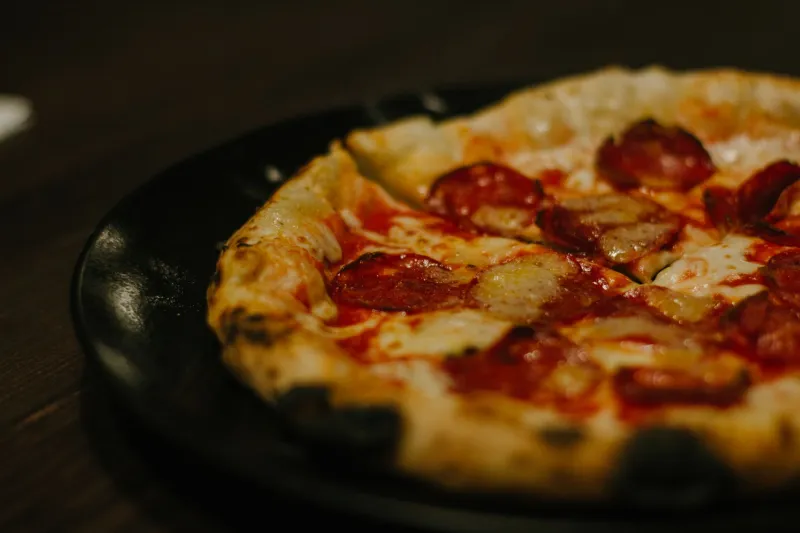
Pepperoni was perfectly positioned. It was shelf-stable, easy to slice, inexpensive to produce, and — crucially — it did something magical when exposed to high oven heat. The fat rendered out, the edges crisped and curled, and those little cups of spiced meat became flavor bombs across the surface of a pizza. No other topping behaved quite like it.
By the 1950s and 60s, as pizza chains began standardizing their menus for mass appeal, pepperoni became the default. It was the safe choice, the crowd-pleaser, the topping that required no explanation. Marketing reinforced what habit had already established, and within a generation, pepperoni and pizza had become so intertwined in the American imagination that separating them felt almost unthinkable.
The Numbers Don't Lie
Today, the statistics are staggering. The American pizza industry uses somewhere in the neighborhood of 250 to 300 million pounds of pepperoni every single year. It appears on roughly 36 percent of all pizzas ordered in the United States — more than the next two most popular toppings combined. It shows up on kids' menus, in school cafeterias, at Super Bowl parties, and on the default "cheese and pepperoni" order that people fall back on when they can't decide anything else.
None of that happened in Italy. Authentic Neapolitan pizza — the kind protected by strict tradition and geographic designation — doesn't use pepperoni at all. The toppings are simpler, the flavors more restrained. American pepperoni pizza is, by any honest measure, an American invention sitting on top of an Italian foundation.
And that's not a criticism. It's actually kind of remarkable.
Tradition and Preference Can Coexist
At Piezano's, we think about this tension a lot. We're deeply committed to the craft side of pizza — the fermented dough, the quality sauce, the cheese that actually melts properly. Those things matter, and we don't cut corners on them. But we're also not interested in being precious about American pizza culture or treating it like something lesser than its Italian roots.
Pepperoni is a genuinely American contribution to pizza history. It was invented here, refined here, and embraced here in a way that reflects something real about how this country absorbs outside influences and makes them its own. Respecting pizza tradition doesn't mean ignoring 100 years of American innovation.
That's why our pepperoni is sourced carefully — we want that characteristic curl, that rendered edge, that hit of spice that makes the topping work. But it sits on a crust and sauce that would make any serious pizza person nod in appreciation. The two things aren't in conflict. They're actually better together.
Why It Still Hits the Same Way
There's a reason pepperoni has never been dethroned despite decades of topping innovation, specialty ingredients, and foodie culture pushing people toward more adventurous choices. It works. The flavor profile — salty, spiced, slightly fatty, with that caramelized edge from the oven — is engineered by decades of refinement to be deeply satisfying in a way that's hard to argue with.
It also carries a lot of memory. For most Americans, pepperoni pizza is tied up in childhood birthday parties, Friday nights, sports events, and the specific comfort of a familiar thing arriving at the door in a warm box. That's not a small thing. Food that carries emotional weight hits differently, and pepperoni pizza has had generations to accumulate it.
So the next time you order from Piezano's and you default to pepperoni — don't feel like you're taking the boring route. You're participating in one of the more interesting accidental food stories in American history. A cured meat invented in immigrant butcher shops, perfected in neighborhood pizzerias, and eventually loved by an entire country.
That's a pretty good origin story for something that just looks like a round piece of meat on a pizza.