Why Saying No to Your Weirdest Pizza Request Is Actually the Kindest Thing We Can Do
Let's get one thing out of the way: we like you. We genuinely want you to be happy when you open that box. Which is exactly why, sometimes, we're going to tell you no.
Not rudely. Not dismissively. But firmly, with a lot of respect for what pizza actually is.
If you've ever ordered from Piezano's and been gently redirected away from, say, ranch drizzle over a clam pie or a seven-topping tower that structurally cannot cook evenly — you're not alone. And if you were initially annoyed by that, we get it. We live in a build-your-own, have-it-your-way food culture. The idea that a restaurant might push back on what you want feels almost rebellious at this point.
But here's the thing: that pushback is intentional, and it comes from a place of caring deeply about what ends up in front of you.
The Problem With Infinite Options
There's a well-documented psychological phenomenon called choice overload — the idea that too many options don't liberate us, they paralyze us. A famous study from Columbia University put it plainly: shoppers presented with 24 varieties of jam were far less likely to buy anything than those who saw just 6. The abundance of options felt exciting at first, but it made the actual decision harder and less satisfying.
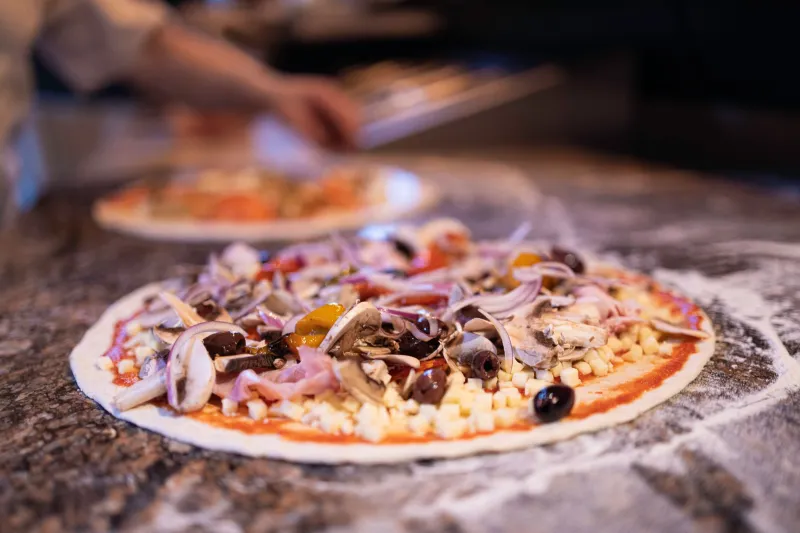
Food menus work the same way. When a pizza place offers 40 toppings, 6 sauce bases, 4 crust styles, and a "make it your own" free-for-all, something gets lost. Not just in the decision-making process, but in the kitchen. The cooks are no longer making pizza — they're managing variables. Quality control becomes a game of whack-a-mole. The thing that made their original pies worth ordering in the first place starts to erode.
At Piezano's, we made a deliberate choice to go the other direction.
What a Focused Menu Actually Does for You
When we say our menu is curated, we don't mean it's small out of laziness. We mean every combination on it has been tested, tasted, argued over, and refined. The ratios matter. The order in which ingredients hit the dough matters. Whether a topping goes under or over the cheese — yes, that matters too.
Take something like our sausage and roasted pepper pie. That combination didn't make the menu because someone thought it sounded good. It made the menu because the fennel in the sausage and the slight sweetness of the roasted peppers create a balance that neither ingredient achieves alone. Add a third or fourth competing flavor, and that balance collapses. The whole thing tastes like confusion.
Customers who've been ordering with us for a while tend to get this intuitively. Marcus, a regular from outside Chicago who orders every Friday, put it well: "I used to be the guy who wanted to customize everything. Then I just started ordering what Piezano's actually offered, and I realized — these people have already done the thinking for me. It's kind of a relief."
That's not a small thing. In a world where every app, every menu, every experience asks you to make seventeen micro-decisions before you get what you came for, having someone say we've got this is genuinely valuable.
The Kitchen Side of the Equation
Here's something most customers don't see: what happens in the kitchen when a wildly off-script order comes through.
Pizza is a high-heat, fast-moving environment. Our ovens run hot — the kind of heat that turns a well-built pie into something remarkable in a matter of minutes. That same heat, applied to a pizza loaded beyond its structural limits, produces something soggy in the middle, burnt at the edges, and barely holding together by the time it reaches your door.
When we decline to add a fifth protein or swap out a foundational sauce for something that doesn't belong in the flavor profile, we're not protecting our ego. We're protecting your dinner.
Our kitchen team has seen it all. The requests that seem harmless but throw off the cook time. The topping combinations that photograph great on social media but taste like a dare. The sauces that curdle under high heat. Saying no to those things isn't gatekeeping — it's quality control with a friendly face.
Constraints Build Trust
There's a reason the best restaurants in the country — the ones with lines out the door and years-long reputations — tend to have relatively focused menus. It's not a coincidence. Constraints force commitment. When you can't hide behind infinite variety, every single item on your menu has to earn its place.
At Piezano's, that's the standard we hold ourselves to. Every pizza we offer, we're proud of. Not "proud of for a fast-casual delivery spot" proud — just genuinely proud. The kind of proud where we'd eat it ourselves on a Tuesday night and not feel like we settled.
That level of confidence only comes from knowing the menu inside and out. From having made these pies hundreds of times and understanding exactly what makes them work. You can't have that relationship with a menu that's infinitely malleable.
What You Can Still Customize — And Why It Works
None of this means you're eating exactly what we feel like making with zero input from you. There's plenty of room within our menu to find your thing. Prefer a lighter hand with the cheese? We can do that. Want to go crust-heavy and skip a topping? Sure. Feeding a group with mixed preferences? Our menu is built with enough range that most tables can find something they love without anyone having to compromise.
The customization we offer is the kind that actually improves the experience — not the kind that turns a pizza into a science experiment.
And honestly? We've found that most people, once they stop trying to engineer the perfect theoretical pizza and just order something we know is good, end up more satisfied than they expected. There's something freeing about trusting the process.
The Bottom Line
We know saying no isn't always what you want to hear. Especially when you've got a very specific craving and a strong opinion about how pizza should work. We respect that.
But Piezano's was built on a belief that great pizza isn't a blank canvas — it's a craft with rules, and those rules exist for a reason. Every constraint on our menu is there because someone in our kitchen fought for it, because the pizza is better for it, and because you deserve something that was actually designed to taste the way it does.
So the next time we gently steer you toward something on the menu instead of off it, just know: we're not saying no to you. We're saying yes to your pizza.