Why Your Pizza Dough Needs More Time Than You Think — And What Happens When It Gets It
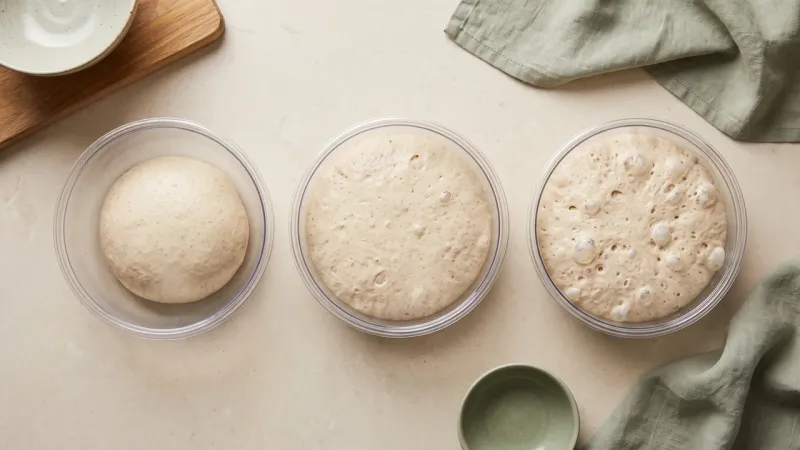
Photo: artisan pizza dough fermentation cold proofing dough balls refrigerator pizzeria, via cdn.fond.kitchen
There's a moment in every home pizza experiment that ends the same way. You've followed the recipe, you've rolled out the dough, you've loaded on the toppings — and then it comes out of the oven looking fine but tasting like... bread with cheese on it. Not bad, exactly. Just not that. Not the pizza you were chasing.
Here's the thing: you probably didn't do anything wrong. You just didn't wait long enough.
The gap between mediocre pizza dough and genuinely great pizza dough isn't usually about ingredients or technique in the conventional sense. It's about time. Specifically, it's about what happens to flour, water, salt, and yeast when you stop rushing them.
What Fermentation Actually Does to Dough
Fermentation is not a buzzword. It's a biological process, and in pizza dough, it's the whole game.
When yeast — whether commercial or wild — begins consuming the sugars in flour, it produces two things: carbon dioxide gas and ethanol. The CO2 creates the bubbles that give dough its lift and open crumb structure. The ethanol and the organic acids produced by fermentation are where flavor actually comes from.
A dough that rises for two hours at room temperature will be technically functional. It'll stretch, it'll bake, it'll hold toppings. But it won't have had time to develop the complex flavor compounds that make a crust taste like something worth eating on its own — that slightly tangy, deeply wheaty, almost nutty quality that you notice in the first bite before any sauce or cheese even registers.
Extend that fermentation to 24, 48, or even 72 hours in a cold environment, and something fundamentally different happens.
Cold Fermentation: The Long Game
Refrigerator fermentation — often called cold proofing — is the standard practice at serious pizza operations, including ours at Piezano's. When dough is moved to a cold environment shortly after mixing, yeast activity slows dramatically. This isn't a problem. It's the point.
At lower temperatures, enzymatic activity continues even as yeast slows down. Enzymes called proteases and amylases get to work breaking down proteins and starches in the flour over an extended period. Protease activity loosens the gluten network in ways that make dough more extensible — easier to stretch thin without springing back. Amylase activity converts more starches to sugars, which feed yeast slowly and also contribute to better browning in the oven.
The result, after a proper cold ferment, is a dough that handles beautifully, bakes with exceptional color, and tastes complex in a way that fast dough simply cannot replicate. At Piezano's, our dough goes through a minimum 48-hour cold fermentation before it ever sees a prep table. Some batches run longer depending on the style we're making.
Sourdough Starters: When Fermentation Gets Wild
Commercial yeast is reliable and fast. A sourdough starter — a live culture of wild yeast and lactic acid bacteria — is something else entirely.
A healthy starter is a living ecosystem. The wild yeasts provide leavening. The lactic acid bacteria produce lactic and acetic acids, which are responsible for that characteristic sour tang and also act as natural preservatives. The balance between these organisms, shaped by temperature, hydration, and feeding schedule, produces flavor profiles that no commercial yeast product can match.
Maintaining a starter requires genuine commitment. It needs regular feeding. It responds to ambient temperature. It can be thrown off by chlorinated tap water. It takes weeks to establish from scratch and months to reach its full potential.
For pizza specifically, the acidity introduced by sourdough fermentation does something beyond flavor: it strengthens gluten development, which means better structure in the final crust. A well-fermented sourdough pizza crust holds its shape under toppings, crisps properly on the outside, and stays slightly chewy in the interior — the holy trinity of great pizza texture.
Gluten Development: The Structure Beneath the Flavor
You can't talk about dough without talking about gluten, the protein network that forms when glutenin and gliadin in flour combine with water and mechanical energy. Gluten is what gives dough its elasticity and what allows it to trap the gas produced during fermentation.
Under-developed gluten tears easily and produces dense, gummy pizza. Over-developed gluten is too tight and elastic, making dough nearly impossible to stretch without it snapping back. The goal is a network that's strong enough to hold structure but relaxed enough to extend gracefully.
This is where time becomes a tool rather than just a waiting period. Resting dough — what bakers call "autolyse" in its early stages — allows gluten to develop naturally without aggressive kneading. Cold fermentation further relaxes the gluten network over time. By the point a properly fermented dough ball reaches our prep table, it stretches to shape with almost no resistance. That's not an accident. That's 48-plus hours of careful process doing exactly what it's supposed to do.
Why This Matters When You're Ordering Pizza
Most frozen pizza dough is made with fast-rising commercial yeast, mixed and formed in a matter of hours, then flash-frozen. The convenience is real. The flavor is the trade-off.
When you order from a craft pizzeria like Piezano's, you're not just paying for better ingredients — though those matter too. You're paying for the time that went into your dough before you ever placed your order. The 48 hours of cold fermentation. The starter culture that's been fed and maintained. The gluten network that developed slowly and properly.
That's not something you can rush at home, and it's not something a frozen product can replicate. It requires planning, space, temperature control, and the kind of patience that commercial food production actively works against.
The Wait Is Built Into Every Order
Next time your pizza arrives from Piezano's, take a second before you dig in and look at the crust edge. If you see an open, irregular crumb with small air pockets of varying sizes, that's fermentation at work. If the underside has a deep golden-brown color with slightly darker spots, that's the caramelization of sugars that slow fermentation made available. If the first bite has a flavor that lingers a little — something subtly complex behind the sauce and cheese — that's 48 hours of biology doing what no shortcut can replicate.
Great pizza is patient pizza. We're glad you don't have to do the waiting yourself.
Explore our full menu at piezanospizzeriamenu.com and taste what the slow process actually delivers.