Why Friday Nights Without Piezano's Just Feel Wrong

It's 6:47 on a Friday. You haven't thought about dinner all day, but the second you close your laptop, something clicks. Not a craving exactly — more like a certainty. You already know what's happening. You already know who you're calling.
That's not laziness. That's not even habit in the boring sense of the word. That's a full-blown ritual, and there's a surprising amount of science behind why it forms — and why, once it does, almost nothing can break it.
Your Brain Is Running a Comfort Algorithm
Neuroscientists who study food behavior talk a lot about something called the reward loop — the cycle of anticipation, consumption, and satisfaction that the brain reinforces over time. Every time you order from a place that delivers exactly what you expected, your brain logs that as a win. Do it enough times and the anticipation itself becomes part of the pleasure.
This is why, by Thursday afternoon, you might already be half-thinking about Friday's pizza. The brain has started running the loop early. It's not hunger — it's memory. And memory, when it comes to food, is one of the most powerful forces in human psychology.
Comfort food research consistently shows that the foods we return to aren't necessarily the most elaborate or expensive options available. They're the ones that deliver reliably. The ones that taste exactly like we remember. The ones that don't surprise us in ways we didn't ask for.
Consistency, it turns out, is its own kind of luxury.
The Moment a Pizzeria Stops Being a Choice
Most people can point to a specific window when a restaurant shifted from "a place I like" to "my place." It's rarely dramatic. Nobody wakes up and decides to be loyal. It happens incrementally — a delivery that showed up hotter than expected, a topping combination that was exactly right, a crust that hit different on a night when you really needed it to.
At Piezano's, that shift tends to happen around the third or fourth order. By then, you've stopped scanning the menu the way you did the first time. You already know what you want. The decision-making part of the evening has quietly been eliminated, and that's not a small thing.
Decision fatigue is real. By Friday evening, most people have made hundreds of small choices throughout the week. The appeal of a dinner that essentially chooses itself — because you already know it's going to be good — is enormous. Your brain isn't being lazy. It's being efficient. It's protecting your energy for things that actually require deliberation.
A pizzeria that earns that kind of trust has done something genuinely difficult. It's removed itself from the competition entirely.
Why "Closer" and "Cheaper" Don't Actually Win
Here's the part that confuses people on the outside: loyal pizza customers will frequently pass over options that are objectively more convenient. A place three blocks away. A chain running a two-for-one deal. A friend's recommendation for somewhere new.
And they'll still open the app and order from their spot.
This isn't irrational. When you've built a ritual around a specific experience, the risk calculation changes. Trying somewhere new on a Friday night isn't neutral — it carries the possibility of disappointment on a night when you specifically didn't want to be disappointed. The expected value of a known great pizza is almost always higher than the potential upside of an unknown one.
Psychologists call this loss aversion, and it's one of the most well-documented quirks in human decision-making. We weight potential losses more heavily than equivalent gains. Applied to pizza: the possibility of a mediocre pie from somewhere new feels worse than just ordering what you know is going to be good.
Loyalty, in this sense, is rational. It's risk management dressed up in mozzarella.
What Makes the Ritual Stick
Not every pizzeria earns this. Most don't. The ones that do tend to share a few specific qualities that go beyond just "good pizza" — though that's obviously the foundation.
Consistency across orders. The pizza you get on your twelfth order has to taste like the one you got on your second. If quality fluctuates, the brain can't build a reliable expectation, and the loop breaks. Ritual requires predictability.
Delivery that respects the experience. A pizza that arrives lukewarm or structurally compromised after the ride over isn't just a disappointment in the moment — it chips away at the trust that took multiple orders to build. The last mile matters more than most people in the food business want to admit.
A menu that feels like it was built for you. Not overwhelming, not gimmicky. Enough variety to keep things interesting over months of ordering, but anchored by the classics done right. The kind of menu where you always know what you want but occasionally discover something new that makes sense alongside everything else.
The sense that someone actually cares. This one is harder to quantify, but customers feel it immediately when it's absent. It's in the quality of the ingredients, the attention to the crust, the way the box keeps everything intact. It communicates something: this was made for you, not just processed for delivery.
Friday Becomes a Framework
What's interesting about the weekly pizza ritual is how it structures the rest of the week around it. Monday through Thursday feel like the approach. Friday is the payoff. It's a small thing — it's just dinner — but small anchors matter more than we give them credit for. They give weeks a shape. They give households a shared rhythm.
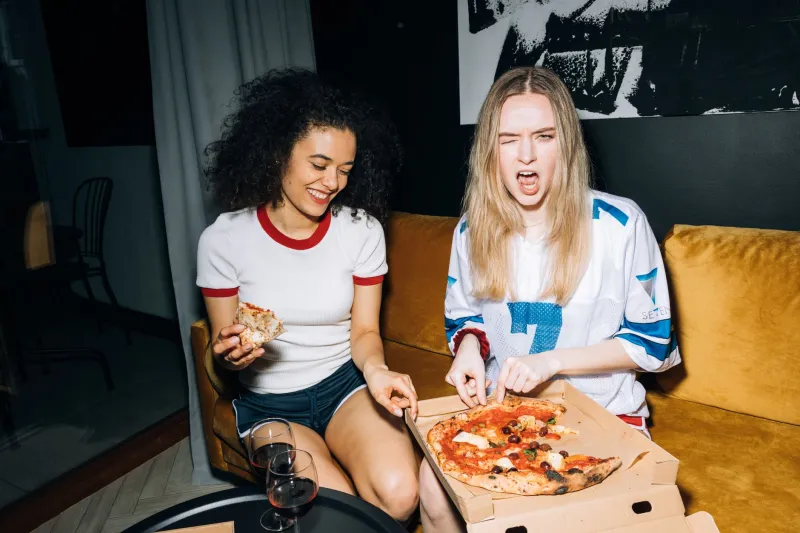
Families build Friday pizza nights into their actual schedules. Couples use it as a decompression ritual after long work weeks. Friend groups make it the default gathering format because nobody has to plan anything — the plan is already the plan.
Piezano's isn't just selling pizza at that point. It's providing a framework for the end of the week. That's a different kind of value entirely, and it's the kind that doesn't show up in a price comparison.
The Non-Negotiable
At some point, for a lot of customers, the question of where to order on Friday simply stops being a question. The consideration phase disappears. Other places still exist — they just don't apply on Friday nights.
That's the Piezano's effect, and it's not manufactured. It's earned, one consistent, hot, exactly-what-you-needed pizza at a time. The neuroscience explains the mechanism. But the reason it happens at all is simpler: when something is reliably good, reliably delivered, and reliably part of the best part of your week, your brain doesn't want to risk losing it.
Friday nights aren't a blank slate. They belong to the pizza that earned them.
And honestly? That sounds about right.