Flour, Water, Fire: Why Technique Beats Fancy Ingredients Every Single Time
There's a certain fantasy that lives in the premium ingredient aisle. You grab the imported San Marzano tomatoes, the hand-pulled fior di latte, the single-origin '00' flour milled in Naples, and you assume — reasonably, honestly — that the pizza will be great. How could it not be? You spent a small fortune on it.
And then it comes out of the oven flat, dense, and weirdly sad.
This is the pizza paradox that professional pizzaiolos have been quietly living with for decades: the best ingredients in the world cannot compensate for weak fundamentals. Meanwhile, a skilled maker with humble pantry staples can produce something that makes you close your eyes on the first bite.
So what's actually going on?
The Hierarchy Nobody Tells You About
If you asked ten serious pizza makers to rank what matters most in their craft, the list would look something like this: dough management first, heat second, sauce balance third, and ingredients somewhere after that. Not because ingredients don't matter — they absolutely do — but because they're the last variable in a long chain of decisions that either work or don't.
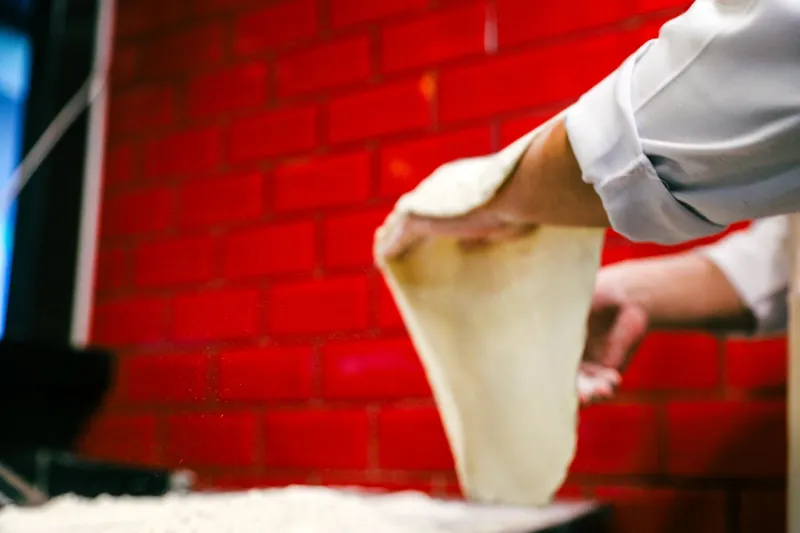
Think of it this way. A perfectly fermented dough, stretched with care and launched into a screaming-hot oven, creates a crust with structural integrity, char in the right places, and a chew that no amount of premium topping can replicate if it's missing. But that same expensive mozzarella sitting on top of a dense, underdeveloped dough? It just melts into a puddle on a cracker.
The dough is the foundation. And foundations aren't glamorous — they're just everything.
What Fermentation Actually Does (And Why Rushing It Costs You)
One of the most counterintuitive things about great pizza dough is that it gets better the longer you leave it alone. Fermentation — the slow, cold process where yeast and bacteria break down sugars and develop flavor compounds — is not something you can shortcut with better flour.
A 24-hour cold ferment on average bread flour will outperform a 3-hour same-day proof with imported Caputo every time. The extended ferment develops complexity, creates those micro-bubbles that give crust its airy interior, and produces the slight tang that makes a good pie taste like more than the sum of its parts.
At Piezano's, the dough process is non-negotiable precisely because of this. The fermentation window isn't treated as a scheduling inconvenience — it's treated as an ingredient in its own right. You can't buy time. You just have to respect it.
Where Ingredients Actually Matter
None of this is to say that ingredient quality is irrelevant. It's just that the return on investment is not linear, and it's heavily dependent on what's already working underneath.
Here's where premium ingredients genuinely move the needle:
Cheese quality is probably the most noticeable variable to the average eater. Low-moisture, whole-milk mozzarella versus the rubbery block stuff creates a dramatically different melt, pull, and flavor. This is worth spending on.
Tomato quality matters enormously in a simple red sauce. A great tomato — sweet, low-acid, with body — doesn't need much done to it. A mediocre tomato needs to be masked with sugar and herbs, which muddies the flavor profile of the whole pie.
Olive oil as a finishing drizzle, not a cooking medium, is where a small quality upgrade pays off in a big way. The grassy, peppery finish of a decent extra-virgin oil on a hot slice is legitimately transformative.
But here's the thing: none of those upgrades matter if the dough is wrong. They're multipliers on a base number. If the base is zero, the multiplier does nothing.
The Corners Worth Cutting (And the Ones That Aren't)
Every pizzeria makes compromises. That's just the reality of running a food business. The question is which compromises destroy the product and which ones are genuinely fine.
Fine to compromise on: the brand of flour, as long as protein content is appropriate. The exact variety of tomato, within reason. Whether you're using fresh basil or a high-quality dried blend. These are finishing touches.
Not fine to compromise on: fermentation time. Oven temperature. Dough hydration ratios. The skill and attention of the person stretching the dough. These are structural. Cut them and the pizza falls apart — sometimes literally.
At Piezano's, the internal standard is simple: if it affects the dough or the bake, it's non-negotiable. Everything else is a conversation.
Why Simple Pies Expose Everything
The clearest way to test any pizza maker's fundamentals is to order the simplest thing on the menu. A plain cheese. A margherita. A marinara with no toppings at all.
Simple pies have nowhere to hide. There's no layer of toppings to distract from a weak crust. There's no complexity of flavor to paper over an underdeveloped sauce. You get the pizza raw and honest, and it either holds up or it doesn't.
This is why the margherita is the professional benchmark. Three components — dough, tomato, cheese — and each one has to carry its full weight. No shortcuts. No distractions.
When someone orders a cheese pizza from Piezano's, that's the pie that tells the whole story. And the whole story starts with technique, long before a single topping gets involved.
The Real Takeaway
Next time you're evaluating a pizzeria — or wondering why your homemade attempt with excellent ingredients didn't land — look at the crust first. Is it light and airy with some char? Does it have a little spring when you press it? Does the bottom have color and structure, not pale softness?
If yes, everything else has a chance. If no, no ingredient upgrade is going to save it.
The best pizza makers aren't the ones with the most expensive pantry. They're the ones who understand that the magic is in the method — and that flour, water, and time, handled with real skill, can do things that no premium label ever could.