Slow Dough, Big Flavor: The Fermentation Science That's Quietly Transforming American Pizza
There's a particular kind of pizza crust that's hard to describe until you've had it. It's got a slight tang that sneaks up on you. The texture is airy but substantial — a little chewy, a little crispy at the edges, with a complexity that plain bread just doesn't have. You finish a couple of slices and realize you don't feel heavy. You feel satisfied.
That crust didn't happen by accident. It took time. A lot of it.
The Rush That Ruined American Pizza Dough
For most of the 20th century, speed was the dominant force in commercial pizza making. Fast-acting yeast, introduced to American kitchens and pizzerias in the mid-1900s, made it possible to go from dry ingredients to baked crust in a matter of hours. For a growing industry that needed to crank out volume, this was a breakthrough.
But something got lost. The slow, biological process of fermentation — where yeast and naturally occurring bacteria work through the dough over many hours or even days — produces flavors and textures that fast-rise methods simply can't replicate. When you cut that time short, you get a crust that's fine. Functional. But not interesting.
American pizza ate that trade-off for decades. We got used to crusts that were vehicles for toppings rather than flavors in their own right. The crust became the thing you tolerate on the way to the cheese.
What Actually Happens During Long Fermentation
Fermentation is a living process. When dough is left to develop slowly — typically between 24 and 72 hours, often in a cold environment — several things happen simultaneously that change the final product entirely.
First, wild yeasts and lactic acid bacteria go to work breaking down the starches and proteins in the flour. This produces carbon dioxide (which makes the dough rise) and organic acids (which produce flavor). The longer this process continues, the more complex the acid profile becomes. That's where the subtle tang comes from — not vinegar, not additives, but natural chemistry.
Second, those same enzymes are breaking down gluten structures in ways that make the dough more extensible and easier to digest. The proteins that can cause digestive discomfort in quickly-made bread are partially pre-digested by the fermentation process itself. Many people who report sensitivity to conventional bread find that long-fermented pizza sits much more comfortably.
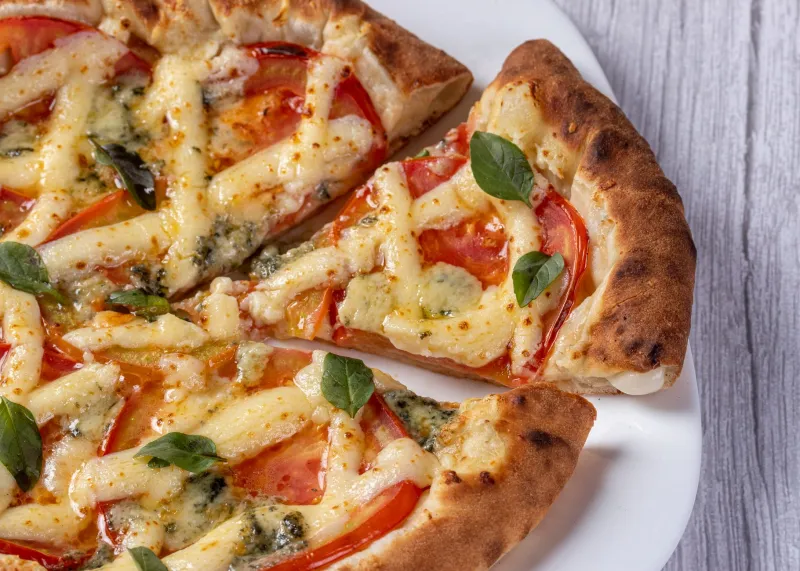
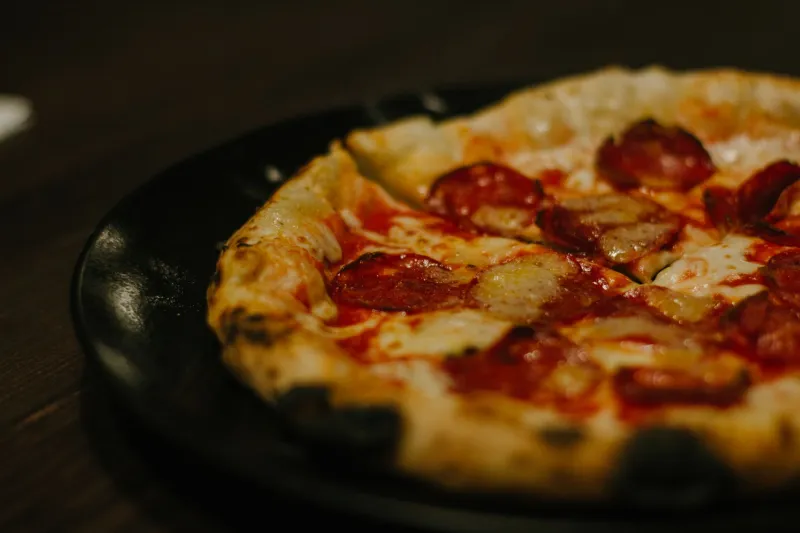
Third — and this is the part that separates good pizza from great pizza — the Maillard reaction during baking is dramatically enhanced. The sugars and amino acids produced during fermentation brown differently, creating those spotted, blistered, almost caramelized edges that you can't achieve with quick-rise dough no matter how hot your oven runs.
Sourdough vs. Commercial Yeast: A Meaningful Distinction
Not all slow-fermented dough is technically sourdough. Some pizzerias use small amounts of commercial yeast and simply extend the fermentation window in a refrigerator. Others cultivate wild yeast starters — the bubbly, living cultures that sourdough bakers feed like houseplants — and use those as the sole leavening agent.
Both approaches produce results that are leagues ahead of same-day dough. But true sourdough fermentation, using a mature wild yeast culture, introduces an additional layer of microbial diversity that deepens the flavor profile further. The specific bacteria in a starter reflect the environment where it was cultivated — the flour, the water, the ambient air. In a real sense, sourdough pizza carries a flavor fingerprint that's specific to where it was made.
That's not marketing language. It's microbiology.
Why This Matters for What You're Actually Eating
The health angle on fermented dough is worth understanding clearly, because it often gets either oversold or dismissed.
Long fermentation doesn't make pizza a health food. But it does change its nutritional character in meaningful ways. The partial breakdown of phytic acid — a compound in wheat that can inhibit mineral absorption — means that nutrients in fermented dough are more bioavailable than in quick-rise alternatives. The reduction in rapidly digestible starches affects how the body processes the carbohydrates. And the presence of live organic acids has documented effects on gut microbiome diversity, though most of these are diminished by the baking process.
What's less diminished is digestibility. People consistently report that well-fermented pizza — particularly sourdough-based — doesn't produce the bloated, heavy feeling that conventional pizza sometimes does. If you've ever eaten three slices and felt surprisingly okay, there's a decent chance fermentation was involved.
How Piezano's Fits Into This Shift
The broader movement toward extended fermentation in American pizzerias isn't a trend driven by food media. It's being driven by pizzaiolos who got tired of mediocre crusts and started paying attention to what the dough actually needed.
At Piezano's, the dough doesn't get rushed. The philosophy is simple: the crust is half the pizza. If the crust is an afterthought, the whole thing suffers, regardless of what you pile on top. Giving dough the time it needs to develop — real time, not fast-tracked time — is the baseline commitment from which everything else follows.
The result is a crust with character. A little chew. A little complexity. Something that holds up to toppings without disappearing under them, and that you actually want to eat on its own.
The Patience Problem, and Why It's Worth It
The obstacle to widespread adoption of long-fermentation pizza is obvious: time is expensive in a commercial kitchen. Dough that takes 48 hours to develop requires planning, cold storage capacity, and a willingness to work days ahead rather than hours ahead.
That investment doesn't scale easily. It's one of the reasons the craft-pizza movement tends to be concentrated in independent shops rather than chains. You can't centralize and distribute slow-fermented dough the way you can standardized quick-rise product without losing most of what makes it worth doing.
But for the pizzerias willing to do the work, the results speak for themselves — one bite at a time.